
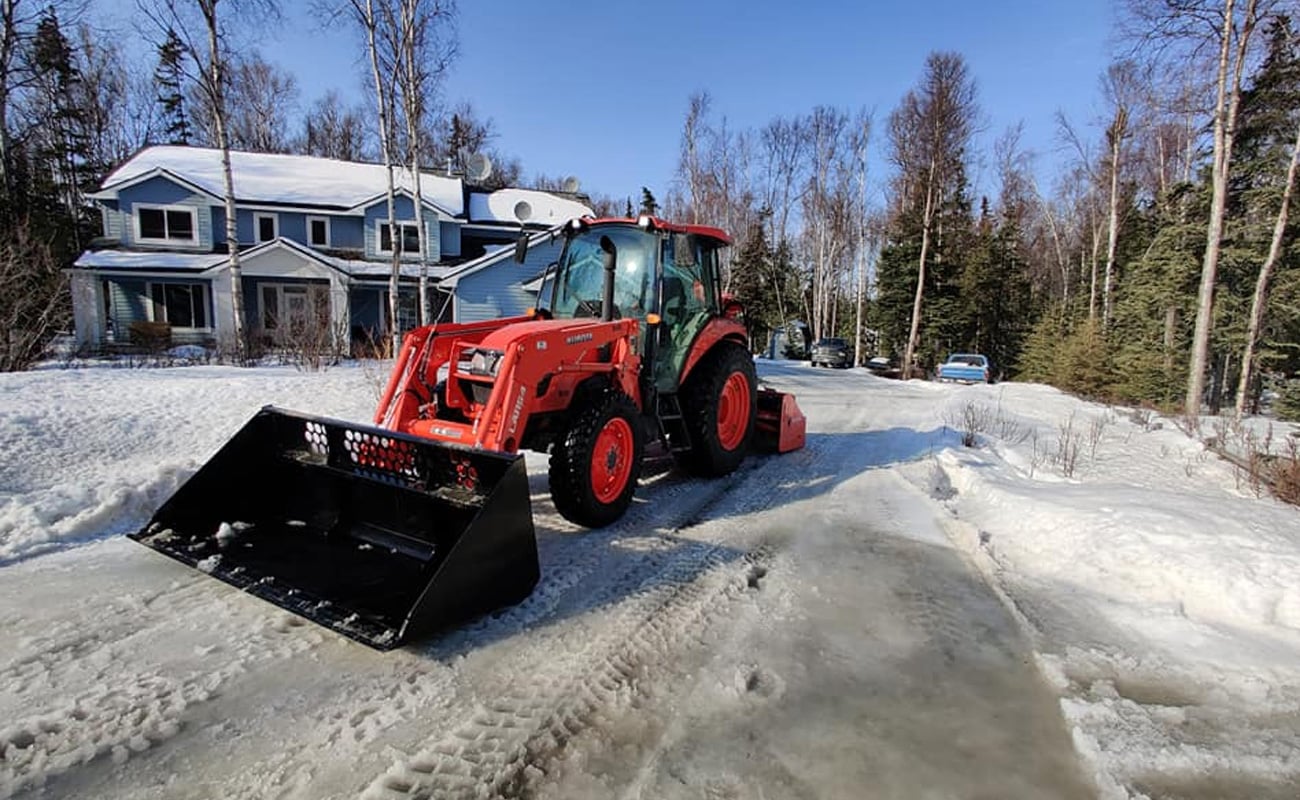
As the winter accumulation starts to stack up against the siding of your home, many homeowners face a technical dilemma: Which is better for my lot, snow plowing or snow blowing? When it comes to snow plowing vs blowing in Anchorage, the answer isn’t just about speed; it’s about the unique layout of your property, the type of surface you’re clearing, and how much “snow storage” you actually have left. Securing the right anchorage snow removal strategy is essential, as choosing the wrong method can lead to torn-up sod, scraped asphalt, or massive ice dams that haunt you until the April breakup.
In Short:
Snow plowing is the fastest method for clearing wide, flat driveways and large volumes of snow, but it requires significant space to “stack” the resulting piles. Snow blowing is a more precise, gentler alternative that “throws” snow away from the driveway, making it the superior choice for tight residential lots, delicate landscaping, and properties with limited storage space where you want to avoid massive, icy snowbanks.
The Power and Speed of Snow Plowing
Plowing is the “heavy hitter” of the Anchorage winter. Most professional services utilize 4×4 trucks equipped with 8-foot to 10-foot steel or poly blades. This method is incredibly efficient for long driveways or large parking pads because it uses raw vehicle power to push massive weights of snow in a single pass. If your primary goal is speed—getting out of the driveway at 6:00 AM after a 10-inch dump—plowing is usually the winner.
However, plowing has its limitations. Because it relies on “pushing,” it naturally creates large, compacted piles at the end of your driveway or the edges of your yard. In a heavy winter, these piles can become “glaciers” that block sightlines and take up valuable parking space. Furthermore, a heavy plow blade can be tough on surfaces; if the ground isn’t perfectly frozen, a plow can easily scrape up gravel or gouge asphalt.
What About a Gravel Driveway?
If you have a gravel driveway, plowing requires a “base layer.” Many Anchorage pros recommend leaving about an inch of packed snow on the ground during the first few storms of the year. This creates a frozen “floor” that protects your gravel from being pushed into the yard by the plow blade later in the season.
The Precision and Cleanliness of Snow Blowing
Snow blowing (or snow throwing) takes a more surgical approach. Instead of pushing the mass, a two-stage snow blower uses a rotating auger to lift the snow and a high-speed impeller to throw it through a chute, often sending it 20 to 30 feet away from the driveway. This is the ideal method for tight residential lots in neighborhoods like South Anchorage or Midtown where there is no room to “stack” snow.
The biggest advantage of blowing is the lack of “windrows” (the long lines of snow left at the edge of a plow blade). Because the snow is dispersed evenly across your lawn, it melts more uniformly in the spring and doesn’t create the massive ice dams that lead to driveway flooding. It is also significantly gentler on your property; since the equipment is lighter and the clearing is done with an auger rather than a heavy scraping blade, your walkway and sidewalk snow shoveling areas remain undamaged.
The “Deep Drift” Defense
In Anchorage, wind is often as big a factor as the snow itself. If your driveway is prone to drifting, a snow blower is often more effective than a plow. While a plow might struggle to push a 4-foot drift of wind-packed snow, a commercial-grade blower can “chew” through the drift layer by layer, throwing the snow downwind so it doesn’t just drift back onto your path.
Which Method Protects Your Landscaping Best?
For many Anchorage homeowners, the biggest concern is the health of their spring garden. Plowing can be devastating to flower beds or delicate shrubs located near the edge of the driveway. When a truck pushes a 500-pound block of snow, anything caught in the path—including your expensive perennials or curb-side trees—will be crushed.
Snow blowing allows for total control over where the snow lands. You can aim the chute away from sensitive plants and toward open lawn areas. This prevents the “compaction” that kills grass and avoids the salt-heavy runoff that often accumulates in large plow piles. If you’ve invested in pet safe ice melt Anchorage , blowing the treated snow evenly across the yard ensures that the chemicals are diluted rather than concentrated in one toxic melting pile next to your prize-winning peonies.
What if Neither Method is Enough?
By late February, even the best blower can’t find a place to put the snow. If your yard is “maxed out” and your driveway has turned into a tunnel, it’s time to stop moving the snow and start removing it. This is where residential snow hauling services become necessary. Instead of pushing or blowing, we load the snow into trucks and haul it to a municipal dump, completely resetting your property’s capacity and preventing the “April Flood.”
Making the Right Choice with Highmark Services
Choosing between a plow and a blower depends on your property’s “personality.” Do you have a 100-yard gravel drive, or a tight, paved lot with a delicate garden? At Highmark Services, we don’t believe in a one-size-fits-all approach. We assess your lot’s layout, drainage patterns, and landscaping to recommend the method that keeps your property clear today and healthy in the spring.
Whether you need the heavy-duty power of a plow or the surgical precision of a blower, Highmark Services has the fleet and the expertise to handle the job. Contact us today for a property assessment and let’s build a custom winter plan that works for your specific lot.