
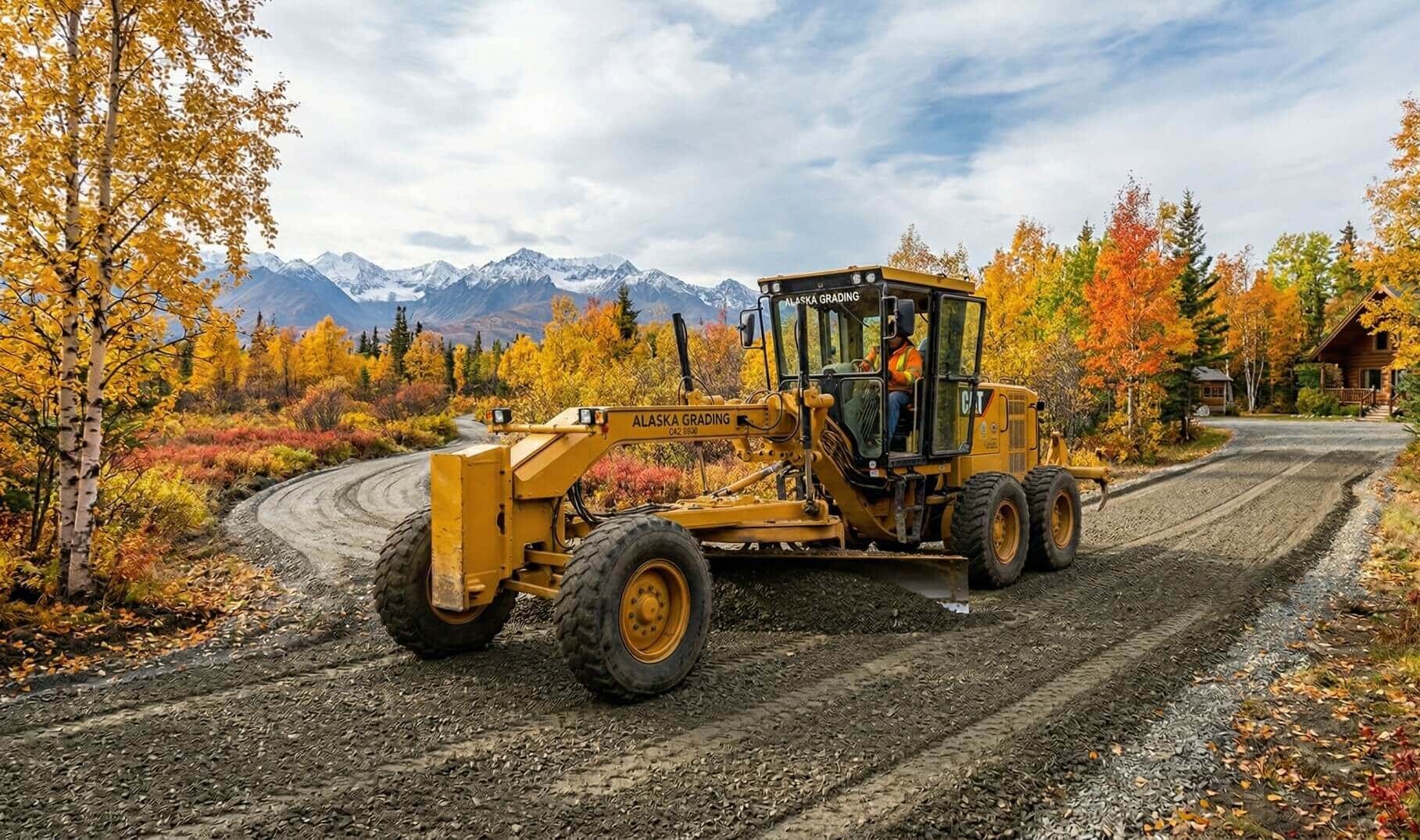
If you live in Alaska, you already know that late summer and early fall trigger a frantic, statewide race against the clock. It is the season of chopping firewood, winterizing pipes, swapping out vehicle tires, and pulling the boats out of the water before the first hard freeze hits. However, amid all this essential winter preparation, property owners often overlook one of their most crucial assets: their driveway.
For homeowners and commercial property managers in Anchorage with gravel driveways or private dirt roads, the timing of your road maintenance is just as important as the maintenance itself. While you might be tempted to put off driveway repairs until the snow melts next year, doing so is a recipe for costly property damage.
When it comes to maintaining a durable, accessible, and safe driving surface, fall is undeniably the best time for gravel driveway grading in Alaska. Here is a deep dive into the science of Alaskan seasons, the mechanics of gravel road degradation, and why booking a grading service before the snow flies is the smartest investment you can make for your property.
The “Goldilocks” Moisture Window
To understand why fall is the ideal season for grading, you have to understand how gravel roads are built. A proper gravel driveway isn’t just a pile of rocks; it is a carefully engineered mixture of crushed stone, sand, and fine dirt particles (often called “fines”). For these materials to lock together and form a hard, concrete-like surface, they require the perfect amount of moisture.
- Summer is Too Dry: During the peak of an Alaskan summer, the ground is often baked dry. If you try to grade a road when it is bone dry, the essential dust and fines simply blow away in the wind. Without these binding agents, the larger rocks stay loose, leading to a surface that feels like driving on marbles.
- Spring is Too Wet: During spring “breakup,” the ground is overly saturated with melting snow. Running heavy equipment over a thawing, muddy road will often do more harm than good, creating deep ruts and destroying the base layer of the road.
- Fall is Just Right: September and October in Anchorage typically bring ambient moisture and light rain. This natural moisture content allows grading equipment to perfectly mix the aggregate. When the damp gravel is compacted, the fines act as a cement, locking the road surface firmly in place just before the ground freezes solid for the winter.
1. Erasing Severe Summer Wear and Tear
Alaskan summers are short, which means we pack an incredible amount of activity into a few months. Your driveway takes a massive beating from heavy RVs, boats being towed in and out, ATVs, and constant vehicular traffic. By September, most gravel roads are suffering from two major ailments: potholes and washboarding.
Washboarding (the series of annoying, teeth-rattling ripples in the road) occurs naturally from the acceleration and deceleration of vehicle tires. Potholes form when water sits in a slight depression, and the pressure of car tires forces the water down, blowing out the dirt and expanding the hole.
If you leave these defects in your driveway over the winter, they will freeze into permanent, rigid obstacles. Grading in the fall completely scarifies (cuts into) the surface, erasing washboarding and tearing out the “false bottom” of potholes to create a fresh, tightly compacted, and smooth slate.
2. Creating a Smooth Canvas for Snowplows
Perhaps the most practical reason to grade your gravel road in the fall is to prepare for winter snow removal. Navigating a heavy snowplow over a heavily rutted, pothole-riddled gravel driveway is a nightmare.
When a plow blade hits an uneven surface, it tends to dig into the high spots. This not only risks causing severe damage to the plowing equipment, but it also ends up scraping away your expensive gravel and launching it into your lawn or neighboring snow berms. Come springtime, you will find half of your driveway material scattered across your grass.
A freshly graded, properly smoothed driveway allows snowplows to glide effortlessly over the surface. If you want to prevent snow plow damage to your property and keep your gravel where it belongs, fall grading is absolutely mandatory.
3. Perfecting the “Crown” for Proper Drainage
Water is the ultimate enemy of a gravel road. The primary goal of professional grading is not just to make the road smooth but to shape it. A properly maintained gravel driveway must have a “crown”—meaning the center of the road is slightly higher than the outer edges. According to the Federal Highway Administration (FHWA) guidelines for gravel roads, a proper crown allows rainwater and melting snow to shed quickly off the sides of the road and into adjacent ditches.
If your driveway has flattened out over the summer, water will pool in the center. In the fall, this pooling rainwater will freeze overnight and thaw during the day. This creates incredibly dangerous, slick ice patches right where you park and walk.
By restoring the crown in the fall, you ensure that late-season rains and early snowmelt are immediately channeled away from the driving surface, preventing your driveway from turning into a treacherous ice rink. (You can read more about managing ice on our guide to handling low-snow winter driveway freezes in Anchorage).
4. Mitigating the Dreaded Spring Breakup Mud
What you do to your driveway in October directly dictates how it will behave in April. When the heavy Alaskan snowpack begins to melt during spring breakup, the water needs somewhere to go.
If your driveway is flat, rutted, and full of potholes when the snow falls, all that melting water will sit on the surface in the spring. As the water seeps into the uncompacted, damaged gravel, it creates a deep, soupy mud bog that can easily trap vehicles and require expensive emergency aggregate delivery to fix.
Conversely, if your road was crowned and compacted in the fall, the spring snowmelt will effortlessly shed off the sides of the frozen, impermeable surface. You will experience significantly less mud, faster drying times, and a driveway that remains fully functional throughout the messiest season of the year.
Signs Your Anchorage Driveway Needs Fall Grading
Not sure if your property requires attention before winter? Take a walk down your driveway and look for these telltale signs:
- Loss of the Center Crown: Does the driveway look flat, or worse, is it shaped like a bowl (lower in the middle than on the sides)?
- Standing Water: After a fall rainstorm, do puddles linger on the road surface for hours or days?
- Severe Washboarding: Does driving over the surface cause your vehicle to rattle violently?
- Vegetation Growth: Are weeds or grass beginning to sprout in the center of the driveway or along the driving lanes?
The Difference Between DIY Smoothing and Professional Grading
Many homeowners attempt to fix their driveways by dragging a box blade or a heavy piece of steel behind a riding mower or a pickup truck. While this might make the road look a little better temporarily, it is just a band-aid.
Dragging simply knocks the tops off of high spots and fills potholes with loose, uncompacted dirt. The very next time it rains, that loose dirt will wash away, and the exact same pothole will reappear.
True professional grading requires heavy machinery, such as motor graders or heavy skid steers equipped with specialized grading attachments. Professionals don’t just fill holes; they cut down to the absolute bottom of the deepest defect, re-blend the aggregate material, establish a precise slope for water runoff, and heavily compact the surface so it stays put.
Don’t Wait Until the Ground Freezes
In Alaska, the window for fall grading is incredibly short. Once the temperatures drop consistently below freezing, the ground frost begins to penetrate the soil. Once the frost is deeper than an inch or two, it becomes nearly impossible for even the heaviest equipment to cut and reshape the gravel properly.
If you want to protect your property, ensure a smooth winter of snow removal, and save yourself from a muddy disaster next spring, the time to act is now.
At Highmark Services, we have the heavy equipment, local expertise, and precision necessary to prep your property for the harsh Alaskan winter. Explore our professional road grading services to learn more about how we can restore your driveway, or contact us today to get on the schedule before the winter freeze locks us out!