

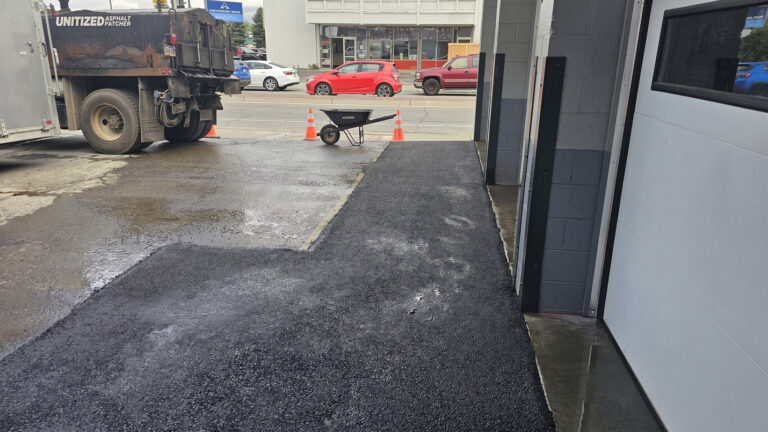
Every August the same calls start coming in. A homeowner off Huffman has a driveway that’s been cracking since breakup and finally has the budget to deal with it. A property manager on Old Seward has a pothole near the loading dock that’s now big enough to have a name. The question is always the same: is there still time to pave this year?
The honest answer is yes, but the clock is running, and the same crews that handle Anchorage property maintenance through every season spend August splitting the calendar between jobs that can finish and jobs that should wait for June. This guide covers when the season actually ends, why temperature matters more than the calendar, and what to do if you can’t make the window.
In Short
Paving season in Anchorage typically runs from mid-May through mid-September. Hot-mix asphalt needs surface temperatures around 50 degrees and rising to compact properly, and by late September, cold nights and cooling ground make that unreliable. If you want new pavement down before winter, schedule the work in August. After that, you’re planning for spring.
When does paving season actually end in Anchorage?
Anchorage’s paving season has no fixed end date, because it ends on temperatures, not the calendar. The season closes when the combination of air temperature, ground temperature, and overnight lows makes it impossible to compact asphalt before it cools. In most years that happens somewhere in mid-September, though the exact week moves around.
Location matters as much as the date. A wide, sun-exposed commercial lot in Midtown can hold paving conditions a week or two longer than a shaded, north-facing driveway on the Hillside, where the ground cools early and stays damp. Elevation works against you too. Driveways up toward Bear Valley and upper Rabbit Creek lose their window before lots down near Oceanview do.
The other constraint is scheduling, and it’s usually the one that catches people. Asphalt plants and paving crews book their September work in August. By the time the first frost warning shows up in the forecast, the remaining calendar is spoken for. The practical deadline isn’t when the plant closes. It’s when the schedule fills.
What temperature is too cold for laying asphalt?
Hot-mix asphalt arrives at roughly 300 degrees and has to be rolled and compacted before it cools past the point where the binder stiffens. Once it does, the rollers can’t achieve density, and low-density pavement is porous pavement. It lets water in, and in this climate, water in pavement is the beginning of the end.
The standard rule of thumb is a surface temperature of 50 degrees and rising. Note that this is ground temperature, not air temperature. A 55-degree afternoon in late September sounds workable, but if the base has been sitting through 30-degree nights, it pulls heat out of the mat from below faster than the crew can compact it. Thin lifts, which is what most residential driveways get, cool fastest of all. A two-inch lift on cold ground can drop out of the workable range in minutes.
Wind speeds things up further. A stiff afternoon breeze off the Chugach strips heat from fresh asphalt at a rate that shortens the compaction window noticeably, which is one more reason fall paving in Anchorage rewards careful timing over optimism.
Insider advice: On a marginal fall day, morning placement on east- and south-facing surfaces buys the most compaction time, and a thicker lift holds heat far better than a thin overlay. If a contractor proposes a thin overlay in late September, ask hard questions.
How do you tell if your pavement will survive one more winter?
Walking the pavement after a rain is the fastest way to triage it, because water tells the truth about asphalt faster than a dry surface does.
Hairline cracks that stay dry underneath, a surface that’s faded gray but flat, and edges that are intact are all signs of pavement that will take another winter with basic crack sealing. Get the cracks sealed before freeze and revisit in spring.
Cracks wider than a finger, potholes deeper than the surface course, or any spot where water disappears into the pavement instead of running off are a different category. Water is already reaching the base, and this winter’s freeze-thaw cycles will work on it every day from October through April. These need patching now, while hot mix is available, even if the full repave waits until next year.
Then there’s the third category: areas that stay wet long after the rain stops, pavement that moves underfoot, and networks of interconnected cracking. That pavement has already lost the argument with the water underneath it, and money spent on the surface this fall is money spent twice. Put it toward base and drainage correction instead, and pave once, properly, in June.
| What you see | The right move this fall | Why |
| Hairline cracks, flat surface, solid edges | Crack seal before freeze | Keeps water out through one more winter |
| Finger-wide cracks, potholes, water soaking in | Patch now while plants run | Freeze-thaw works on open base all winter |
| Alligatored areas, soft spots, standing water | Fix base and drainage now, repave in June | Surface money on a failed base is spent twice |
One more test worth doing in August specifically: look at where the snow sat longest last spring. Those late-melt zones are your lot’s cold, shaded, wet spots, and they’re where pavement fails first. If the failing areas and the late-melt areas are the same areas, drainage is the disease and the cracking is the symptom.
Should you patch now or repave next spring?
The patch-or-repave decision comes down to what’s failing, not how bad it looks.
If the pavement has isolated cracks and a few potholes but the surface around them is solid and flat, patch and seal now. The single most damaging thing that happens to Anchorage pavement is water getting into cracks before winter. Water expands roughly nine percent when it freezes, and our shoulder seasons cycle above and below freezing over and over, especially during breakup. Every unsealed crack in October is a wider crack in May. Sealing before freeze is cheap insurance.
If you’re seeing alligator cracking spread across large areas, spots that are sinking, or pavement that flexes and pumps water when you drive over it, the problem is under the asphalt, not in it. Patching a failed base is a bandage on a structural problem. The better play is to spend this fall fixing the cause, which usually means drainage and base corrections while excavation season is still open, then repave in June on a base that’s had the winter to settle.
What does the first winter do to new asphalt?
New asphalt keeps hardening for months after placement, which means pavement laid in September spends its most vulnerable stretch under snow and plows. That’s not a reason to avoid fall paving. It’s a reason to plan the winter around it.
The main risks are mechanical. Plow blades can scuff soft edges and catch high spots, and the borders of a new driveway are easy to chew up when nobody can see where pavement ends and lawn begins. Mark the edges with driveway stakes before the first storm, and make sure whoever plows the property knows the pavement is new. Highmark’s plow crews run adjusted blade technique on first-year asphalt for exactly this reason, and on curing commercial lots the crews lean on sanding for traction rather than heavy chemical treatment. Come spring, getting that sand swept up promptly matters too, since a season’s worth of grit under tires works like sandpaper on a young surface.
What if you miss the window this year?
Missing the paving window still leaves the fall to get ahead of everyone who waited until spring. The base work that determines how long pavement lasts doesn’t need warm weather the way hot mix does. Grading and excavation can run into October, which means you can have the driveway cut, shaped, and compacted this fall, let it settle and prove itself through breakup, and have hot mix down in June before the summer rush even forms a line.
Two things to handle before freeze either way. First, fix any spot where water stands on or beside the existing surface, because standing water in September is an ice sheet in November and a washout in April. Second, if the current surface is gravel, a late-season grading pass sets it up to plow cleanly all winter instead of freezing into craters.
Who does asphalt paving in Anchorage?
Highmark Services handles asphalt paving, patching, and repair in Anchorage, with the same company doing the excavation and grading that a lasting pavement base depends on, and the snow removal that protects it afterward. One contractor carries the driveway from dirt to pavement to plowed, which keeps the base, the surface, and the winter care working together instead of being three different companies’ problems. Paving runs through roughly mid-September; call 907-782-6339 or visit highmarkservicesak.com to get a site visit scheduled while the season is open.
Frequently Asked Questions
Can asphalt be patched after paving season ends? Permanent hot-mix patching ends when the plants close for the season, usually around the same mid-September window as paving. Cold-patch material can hold a pothole through winter, but it’s a temporary fix that gets replaced with hot mix in spring.
Can you pave over an existing driveway? An overlay over existing asphalt works only when the pavement underneath is structurally sound. Overlaying alligatored or sinking pavement transfers the old failure into the new surface within a season or two, which is why an honest assessment comes before any overlay quote.
How long does new asphalt need before winter? New asphalt can take traffic within days but keeps curing for months, so pavement placed in late season goes into winter young. It handles that fine when edges are staked, plowing is done with the surface in mind, and traction comes from sand rather than aggressive scraping.
Is asphalt or gravel better for a steep Anchorage driveway? Asphalt holds its shape on grades where gravel washes and washboards every season, but it costs more up front and depends entirely on drainage done right. Steep gravel driveways that fight erosion every year are the strongest candidates for paving.
Getting on the schedule
Highmark Services runs excavation, grading, and asphalt work across Anchorage. Deciding between paving this fall or building the base now and paving first thing in spring takes one site visit. Call 907-782-6339 or reach out through highmarkservicesak.com. The September calendar fills from the front, and the spring list does too.