
In August, a commercial lot in Anchorage looks like it has all the time in the world. The pavement is dry, the pothole by the dumpster enclosure is just a pothole, and winter feels like an abstraction. Then the first measurable snow lands, typically in mid-October, and everything on the maintenance list that didn’t get done becomes either more expensive or impossible.
Contractors who handle snow removal in Anchorage build their commercial routes weeks before that first storm, which puts the real deadline in September. Commercial parking lot maintenance in Anchorage is really a two-season job compressed into one: what you fix between now and mid-October determines what winter costs you between November and April. This guide covers the four things worth scheduling now, in the order their windows close.
In Short
Between August and mid-October, Anchorage commercial properties should get four things done: repair pavement while asphalt plants are still running, correct drainage low spots, sweep the lot down to clean pavement, and lock in a snow removal contract. All four get harder or impossible once the first storm lands, and two of them, paving and contractor capacity, usually close out weeks before the snow arrives.
When does the first plowable snow usually arrive in Anchorage?
The first measurable snowfall typically lands in mid-October, with a sticking base established by early November. But averages are exactly how properties get caught. The first plowable storm has arrived in late September before, and a property that planned around “mid-October” spends that morning finding out which contractors return calls during a storm. The answer is: the ones talking to their contracted clients.
The date that actually matters for planning isn’t the first storm. It’s the point at which the things on this list stop being schedulable. Pavement repair depends on paving season, which closes around mid-September. Snow route capacity fills through September as contractors build their winter schedules. By the time a storm is in the forecast, both windows are shut.
Why do potholes get dramatically worse under plows?
A plow blade turns a surface defect into a demolition project. Every pass, the cutting edge strikes the pothole’s downstream lip, breaking pavement loose a little at a time. Meanwhile water works into the exposed base, and every freeze-thaw cycle wedges the hole wider. A pothole that would have been a routine patch in September routinely becomes a full-depth repair by March, and the freight keeps running all winter whether anyone is watching or not.
There’s a liability dimension too. A pothole in August is visible, and people step around it. The same pothole under two inches of fresh snow is invisible to pedestrians and drivers alike. Documented, timely repair of known pavement defects before the season starts is one of the simpler risk reductions available to a property manager, and it’s only available while the plants are running.
What does drainage have to do with ice management?
Drainage determines where the winter’s ice forms, because every low spot on the lot is a pre-drilled location for it. Anchorage winters swing between thaw and hard freeze repeatedly, and each swing sends meltwater to the same low spots, where it refreezes overnight into sheet ice, usually in the highest-traffic places: entrance aprons, the lanes in front of doors, the sags where storm drains have settled.
Sanding manages that ice all winter, and a good sanding program is part of any serious commercial contract. But a lot with bad drainage needs sanding constantly in the same spots, while a lot with corrected grade needs it after storms. The difference across a full season is real money and real slip exposure. August and September are when grading and drainage corrections are still possible, so the fix is available exactly once before winter. While you’re at it, walk the building perimeter and note any downspout that discharges across a walkway. That detail alone quietly produces more winter slip hazards than almost anything else on a commercial site.
Why sweep the lot in fall and not just spring?
A fall sweep changes how the winter itself goes, while the spring sweep cleans up after it. A lot that goes into the season clean lets the first plow passes run tight to the pavement, which sets up the whole winter’s surface. A lot carrying leaves, gravel, and debris gets that material frozen into the base layer, where it rides along all season.
The storm drains are the bigger issue. Leaves and debris that wash into catch basins in October are still there during the first midwinter thaw, and a blocked basin during a thaw turns a drainage swale into a skating rink within a day. Sweeping and clearing basins before freeze keeps meltwater moving all winter. Then, yes, the spring sweep still happens, because winter sanding leaves material behind by design. Fall and spring sweeps do different jobs; skipping the fall one just makes winter harder.
When should you lock in a snow removal contract?
A commercial snow contract should be signed before the first storm, realistically by the end of September. Contractors build routes in advance, and route position matters: properties on the schedule get serviced in order during a storm, while properties calling mid-storm get whatever’s left, at whatever it costs.
Early signing has a second advantage that’s easy to undervalue: the site walk happens while the pavement is visible. The operator sees the curb lines, the islands, the speed bumps, the pothole locations, and the drainage patterns, and the contract can be scoped properly. That means deciding between per-push and seasonal pricing, whether sanding is included, whether berm removal is needed along road frontage, and, for lots without spare ground, whether snow hauling needs to be in the plan, because a full parking lot has nowhere to push snow by February and that conversation is much cheaper in September.
Insider advice: Walk the lot with your contractor in the fall and agree on snow storage locations in writing, marked on a simple site map. It prevents the two most common spring disputes, landscape damage and surprise hauling charges, before they can happen.
Per-push or seasonal pricing, and which fits an Anchorage winter?
Both structures are common here, and the right one depends on the property’s tolerance for variance more than anything else.
Per-push pricing charges for each service event, so a light winter costs less and a heavy one costs more. It fits properties with flexible budgets and owners who are comfortable riding the variance of an Anchorage season, which is a real ride. Snowfall here swings widely year to year, and a per-push contract in a heavy winter can run well past what anyone penciled in October. It also creates a quiet incentive problem on marginal storms, where a property manager starts making weather judgment calls that are better left to the operator.
Seasonal pricing sets one number for the winter regardless of snowfall. It costs more than per-push in a light year and less in a heavy one, and its real product is predictability: the budget is fixed in September, and every storm is covered without a decision or an invoice surprise. For retail and medical properties where the lot simply must be open every morning, seasonal contracts also remove any ambiguity about whether a given storm counts.
| Per-push | Seasonal | |
| Cost pattern | Tracks the winter; cheap in light years, expensive in heavy ones | Fixed in September regardless of snowfall |
| Budget certainty | Low; Anchorage snowfall varies widely year to year | High; one number for the season |
| Marginal storms | Requires a service decision each time | Covered automatically, no judgment calls |
| Best fit | Flexible budgets comfortable with variance | Properties that must open every morning |
Whichever structure fits, scope matters more than price structure. A cheap contract that covers plowing only, with sanding, berm removal, and hauling all billed as extras, routinely costs more by March than a complete seasonal number. Ask what happens after a heavy week when the storage piles are full, what the sanding trigger is, and who monitors the freeze-thaw cycles between storms. The answers reveal more about a contractor than the per-push rate does.
Who does commercial snow removal in Anchorage?
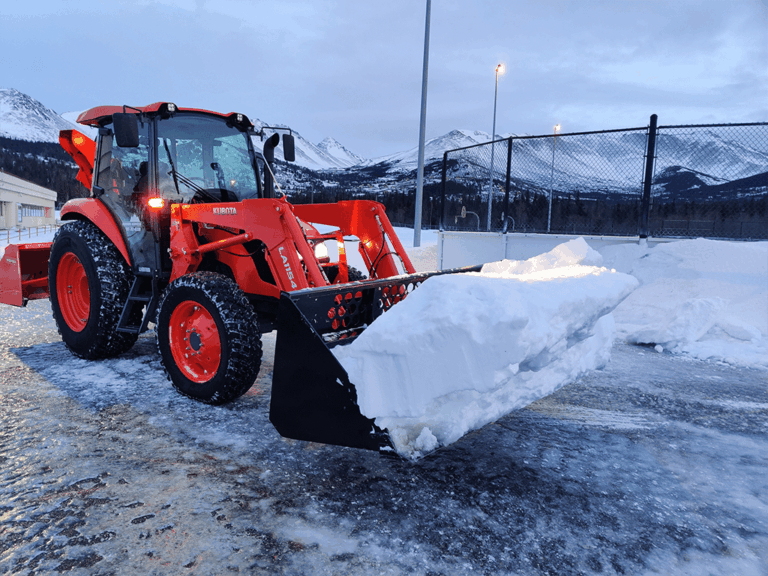
Highmark Services provides commercial snow removal in Anchorage with route-based plowing, sanding, berm removal, and hauling for South Anchorage properties, and new commercial routes are now opening in Midtown for this winter. The same company handles the fall pavement, drainage, and sweeping work that determines how the winter goes, so the lot gets prepared and maintained by one contractor. Contracts are scoped with a pre-season site walk; call 907-782-6339 or visit highmarkservicesak.com before routes fill in September.
What does documentation look like for winter liability?
Without giving legal advice, the general standard commercial properties are held to is reasonable care, and the practical currency of reasonable care is records. A contract with a scheduled route is itself documentation that the property arranged for professional snow and ice management. Service logs showing plow and sanding dates and times build the rest of the record. A property that can show pavement defects were repaired in September and the lot was serviced on a schedule all winter is in a fundamentally different position than one that managed snow ad hoc.
Frequently Asked Questions
When do Anchorage snow removal contracts fill up? Commercial routes are largely built by the end of September, and the best route positions go to properties that signed while contractors were still planning capacity. Signing after the first storm means taking whatever slots remain.
What should a commercial snow contract include? A complete commercial contract covers plowing, sanding, berm removal along frontage, and a plan for hauling once on-site storage fills, along with defined trigger depths and service timing. Plow-only contracts push the rest into per-call extras that add up fast.
Is fall sweeping different from spring sweeping? Fall and spring sweeps do different jobs on the same lot. The fall sweep clears debris and catch basins so the winter’s plowing and drainage work properly, and the spring sweep removes the sand that winter traction work leaves behind by design.
Who is responsible for clearing sidewalks at commercial properties? Sidewalk clearing responsibility varies by location and frontage in Anchorage, and the safe assumption is that walkways customers use are the property’s problem the moment someone slips. Confirming what your snow contract covers on sidewalks and entrances belongs in the fall site walk.
The list, in order
Pavement repairs first, because that window closes in mid-September. Drainage and grading corrections second, while excavation season is open. A fall sweep with clear catch basins third. And a signed snow contract with a completed site walk before the routes fill. Highmark Services handles all four across Anchorage. Commercial snow routes for the coming winter are filling now, including new Midtown routes. Call 907-782-6339 or visit highmarkservicesak.com to get the site walk on the calendar while the pavement is still bare.