

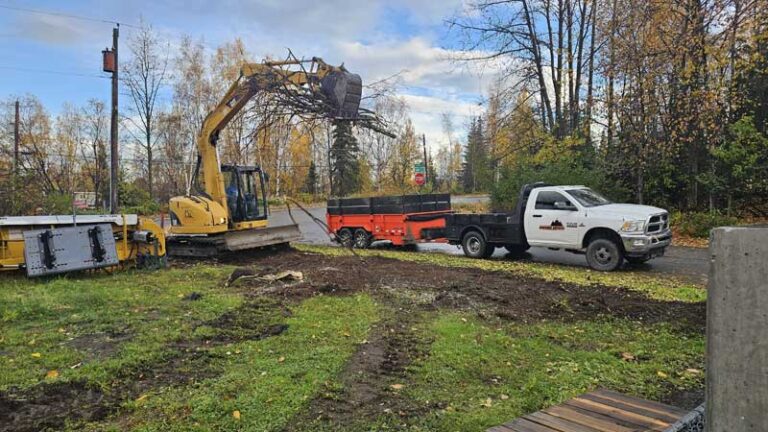
There’s a drainage problem somewhere on your property that you’ve been watching all summer. Maybe it’s the wet corner of a Bear Valley lot that never fully dried out after breakup, or a Rabbit Creek driveway culvert that’s been half-crushed since the last owner. August is the month it either becomes a project or becomes another winter of ice.
Excavation sits at the front of the fall schedule for snow and property services in Anchorage, because it runs against a hard deadline that doesn’t negotiate: frost in the ground. This guide covers when that deadline actually lands, what work can still start now and finish comfortably, and what happens to projects that lose the race.
In Short
Excavation season in Anchorage effectively ends when frost penetrates the ground, usually between mid-October and early November at lower elevations and a few weeks earlier on the upper Hillside. Projects that start by the end of August finish comfortably. Projects that start in October are racing the freeze, and the ones that lose usually cost more to fix in spring than they would have cost to finish on time.
When does the ground actually freeze?
Air frost and ground frost are two different deadlines, and it’s the second one that ends the digging. Anchorage typically sees its first air frosts in September, but soil holds summer heat for weeks after that. Real frost penetration, the kind that turns the top layer of ground into something you break rather than dig, usually arrives between mid-October and early November near sea level.
Elevation and exposure move that date. Lots up Bear Valley and the upper Hillside freeze ahead of Klatt or Oceanview, sometimes by two or three weeks. Aspect matters too. A shaded north-facing slope locks up while a sunny pad across the road is still workable.
Snow timing adds a twist most people don’t expect. An early, heavy snowfall actually insulates the ground and slows deep frost, while a cold, snowless October drives frost down fast. Either way, once the crust forms, everything about excavation gets slower and more expensive. Machines fight the ground, production drops, and the bigger problem shows up at the end of the job: backfill full of frozen chunks can’t be compacted properly, and that failure doesn’t show itself until the material thaws and settles next summer.
What excavation projects can still start in August?
More residential projects fit the remaining season than most owners assume. A typical job, whether that’s a drainage correction, a driveway cut or widening, a culvert replacement, or a French drain, runs days rather than weeks. Starting in August or early September leaves comfortable margin, including room for the weather delays that September likes to hand out.
August is also the right time to start site prep that’s really aimed at next year. A building pad or garage site excavated and rough-graded this fall gets a full winter and breakup to settle and reveal any soft spots, which makes for a far better surface to build on in May than ground that was cut two weeks before the foundation crew arrived. The same logic applies to driveway bases intended for asphalt next spring.
The constraint at this point in the year is rarely the calendar. It’s the schedule. Every excavation contractor in town is working the same deadline, and September calendars are built out of August phone calls.
Insider advice: Utility locates through 811 are required before digging and take lead time, so build that into your timeline now rather than discovering it in October. And if your project ends with finish grading, book the excavation and the grading as one mobilization. Two separate visits means paying for the machine to show up twice.
What makes digging in Anchorage different from digging anywhere else?
The ground itself changes character block by block across the Anchorage bowl. The Hillside sits largely on glacial till, a dense mix of gravel, cobbles, and boulders that digs hard, drains fast in some pockets and not at all in others, and occasionally hands the operator a rock the size of an appliance. Lower elevations toward Klatt and Oceanview shift into siltier soils that hold water, and parts of the bowl sit over the clay layers this town learned about the hard way in 1964. What a dig costs and how it behaves depends heavily on which of these your lot is sitting on.
This is why drainage projects here can’t be designed from a template. A French drain that works perfectly in free-draining till does nothing useful in silt, and a culvert sized for a normal rain year gets tested hard during breakup, when weeks of stored snowmelt move through it in days. An experienced local operator reads the spoil pile as it comes out of the ground and adjusts, which is a skill that shows up in how the project performs next April rather than in the estimate.
Groundwater is the other local variable. Plenty of Hillside and Rabbit Creek properties have seasonal springs that run silently under the surface all summer and then announce themselves in winter as a growing sheet of ice across the driveway. August and September, when the water table is near its yearly low, is the best window in the calendar to intercept and redirect that water, both because the digging is easier and because you can actually see what you’re solving before it turns to ice.
What happens if a dig runs into freeze-up?
A dig that runs into freeze-up compounds its own damage all winter. An excavation left open freezes from the walls inward. Frost heave shifts anything set in the hole, including pipe bedding and form work. Stockpiled material freezes into a solid mass that can’t be placed until it thaws. Then breakup arrives and the open walls slough, undoing work you already paid for.
The tempting shortcut, rushing backfill in the last week of October with half-frozen material, is the most expensive mistake of all. Frozen chunks in backfill leave voids, and when they thaw in June the surface above them drops. That mystery dip that appears in a driveway or beside a foundation the summer after a late dig is almost always this.
| Finish before freeze | Winterize and finish in spring | |
| Best when | Work can complete by mid-October with margin | Freeze-up is close and backfill would be rushed |
| Main risk | Weather delays compressing the compaction work | Open walls sloughing during breakup if shutdown is sloppy |
| Spring result | Settled, finished ground | Clean restart on a stabilized site |
| Worst version | Frozen backfill, voids, summer settling | An abandoned hole with no winterization at all |
Sometimes the professional call is to stop, winterize the site properly, and finish in spring. It’s a worse feeling in October and a much better outcome in June.
Why fix drainage before winter instead of waiting for spring?
Water that stands in September becomes ice in November, and ice problems grow all winter. A wet spot at the base of a slope doesn’t stay a wet spot. It builds into a sheet of glaciation across the driveway that thickens with every freeze cycle. Sanding keeps that ice walkable and driveable through the winter, and it’s a service worth having on the route, but sand manages the symptom. Grade and drainage fix the cause.
Spring makes the same problem worse before it gets better. During breakup, weeks of snowmelt run across ground that’s still frozen and can’t absorb anything, so all that water follows whatever grade existed the previous fall. Fix the grade now and this coming breakup runs where you want it to. Wait until spring and you spend April watching the problem at full volume while the ground is too saturated to work. A properly shaped and crowned surface heading into freeze is the single best predictor of a dry breakup.
How do you winterize a site that won’t be finished?
If a project genuinely can’t close out before freeze, a deliberate shutdown protects the work and the winter around it. Rough-grade the site so snow equipment can operate nearby, and decide now where snow will be stored, because a construction site with no snow storage becomes a snow hauling bill by January. Mark every hole, drop-off, and material pile with high-visibility stakes tall enough to show above the snowpack, both for safety and so plow and tractor operators know exactly where the edges are. Stabilize cut slopes, cover exposed bedding, and get water moving away from the open work.
For projects that keep running through winter, road maintenance and winter grading keep access roads and staging areas passable, which is its own planning conversation and worth having before the first storm rather than during it.
Who does excavation work in Anchorage?
Highmark Services is an excavation contractor in Anchorage handling drainage corrections, driveway cuts, culvert work, and site prep across Anchorage, with the same company grading, plowing, and sanding many of those properties the rest of the year. One contractor across the dig, the grade, and the winter after it means the drainage fix gets judged by how the driveway behaves in January, and built accordingly. Call 907-782-6339 or visit highmarkservicesak.com; projects booked by late August finish with margin before freeze.
Frequently Asked Questions
Do you need utility locates before excavating in Anchorage? Utility locates through 811 are required before any digging, and the marking takes lead time, so the call belongs at the start of project planning rather than the week the machine arrives.
Do excavation projects need a municipal permit? Some projects require municipal permits and some don’t, depending on scope, location, and what the work touches. Requirements vary enough that permit questions get answered per project during scoping rather than assumed either way.
Can excavation happen in winter in Anchorage? Winter excavation is possible with frost ripping and extra equipment time, but it costs meaningfully more, and backfill placed frozen can’t be compacted reliably. Winter digs are for emergencies like line breaks, not for projects that could have run in September.
How long does a residential drainage project take? Most residential drainage corrections run a few days on site, not weeks. The schedule pressure in fall comes from contractor availability and weather margin, not from the length of the dig itself.
The August window
Highmark Services takes on excavation and grading projects across Anchorage. If there’s a dig on your list this year, August is when it gets a comfortable finish date instead of a race. Call 907-782-6339 or visit highmarkservicesak.com to get a site walk on the calendar; the scope conversation settles quickly whether it’s a this-fall project or a build-the-plan-for-spring project.