

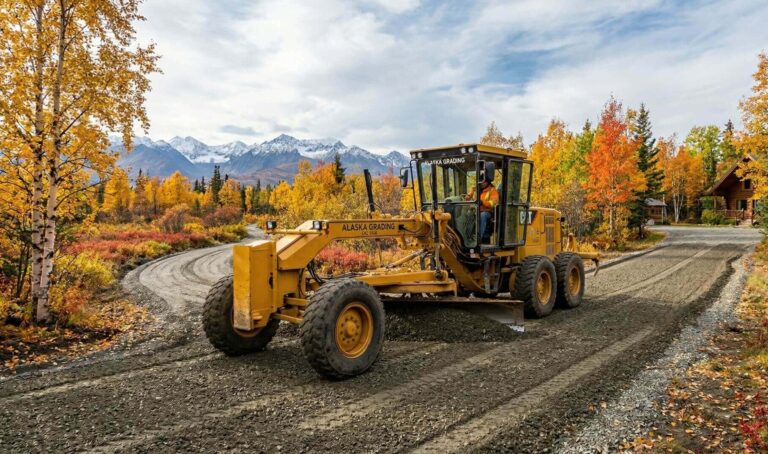
Drive the long gravel driveways in Anchorage during August and you can read the year’s history in the surface: washboard on the grades, potholes at the bends, a high center where the crown used to be. Every owner of one of these driveways eventually asks the same question. How often does this actually need to be graded to stay ahead of it?
The answer is tied to winter more than summer, because the surface a grader shapes in August is the surface Anchorage snow removal equipment rides on from November to April. Gravel driveway maintenance in Anchorage runs on the freeze’s schedule: whatever shape the driveway is in when the ground locks up is the shape it keeps until May. This guide covers the realistic maintenance frequency, why the annual pass belongs in late summer, and what a proper grading pass involves beyond dragging a blade down the middle.
In Short
A gravel driveway in Anchorage needs one corrective grading pass per year at minimum, and steep or heavily used driveways do better with two: a light touch-up after breakup and the full grade in late summer. The late-summer pass is the one that matters most, because the ground freezes by early November and locks whatever shape exists into place for six months. Graded smooth, it plows clean all winter. Left rough, it freezes into craters until breakup.
How often should a gravel driveway be graded here?
Once a year, late summer, is the realistic minimum for a driveway that sees daily use. Steep, long, or heavily trafficked driveways often justify two passes: a light touch-up after breakup to knock down the worst of the spring damage, and the full corrective grade in August or September that sets up the winter.
The driveway will tell you when it’s due. Standing water after rain, washboard forming on the hills, potholes that come back within weeks of being filled, and grass taking hold on the center line are all the same message: the shape is gone and the water is in charge.
Why does the annual pass belong in late summer instead of spring?
Spring ground in Anchorage doesn’t hold a grade, because spring is breakup. In April and May the top of the driveway is saturated, the base underneath is still partly frozen, and grading that material just smears mud around. Any shape you cut into it disappears with the next thaw cycle.
August and September are the opposite. The material is dry enough to cut, move, and compact, and there are still weeks for traffic and rain to settle it before freeze. Then the freeze does you a favor: it locks the corrected shape in place for six months, almost like letting concrete set. A driveway that goes into winter with a proper crown comes out of winter with a proper crown, and the spring touch-up, if it needs one at all, is light work instead of a rebuild.
What do potholes and washboard do to snow removal?
Potholes and washboard degrade every plow pass of the winter, because blades and blowers ride the surface underneath the snow. Every defect in the gravel becomes a defect in the winter maintenance, all season long.
Potholes pack with snow on the first storm, that snow compresses under tires, and by December each hole is a hard ice pocket that no blade can reach. Washboard and pothole lips do something worse: they catch the cutting edge. When a blade snags a lip, it either bounces, leaving stripes of packed snow behind, or it bites, tearing gravel out of the driveway and throwing it into the snow berms and the yard. That gravel doesn’t come back on its own. It’s what spring clean-ups and sweeping spend May removing from lawns, and it’s material you eventually pay to replace.
A rough surface also forces the operator to run the blade higher for the whole season. Higher blade means a layer of compacted snow left behind on every pass, and compacted snow under traffic turns into polished ice, which means more sanding to keep the driveway safe. One late-summer grading pass quietly reduces every one of those problems: the blade rides clean and low, the gravel stays where it belongs, and the ice layer never gets established.
Insider advice: Set reflective driveway markers before the first storm so operators can hold the edges precisely, and consider having a few yards of gravel delivered this fall to stockpile for spring soft spots. Getting a small load delivered in April, when every truck in town is busy, is much harder than arranging it in September.
What does proper grading actually involve?
A corrective grade reshapes the driveway rather than smoothing the top of it. A driveway that’s been through a few Anchorage winters has usually lost its shape in a predictable way: the crown has flattened or inverted, material has migrated from the wheel paths to the edges, and fines have washed downhill on every grade. Dragging a blade over the top of that just polishes a bad shape.
A real grading pass cuts the high center, pulls the migrated material off the shoulders and back into the roadway, restores the crown so water sheds to both edges instead of running down the wheel ruts, opens up the ditch line so that water has somewhere to go, and compacts the result. Where the base has thinned, it means adding fresh material, not just redistributing what’s left. On steep Hillside driveways this matters double, because every rainstorm carries fines downhill and the crown disappears faster than it does on flat ground. If water is arriving on the driveway from somewhere else on the property, that’s a grading-adjacent problem worth solving while excavation season is still open.
Can you grade a driveway yourself with a box blade or a rake?
For a short, flat driveway with a healthy base, a homeowner with a tractor and a box blade can absolutely keep the surface presentable, and plenty of people up here do. The honest limits show up in three places.
First, compaction. A blade can shape material but it can’t densify it, and uncompacted gravel doesn’t hold shape through freeze-up. It gets pushed back out of position by the first few weeks of tire traffic, which is why DIY-graded driveways often look great in September and rutted by Thanksgiving. Equipment weight and a compaction pass are most of what separates a grade that survives winter from one that doesn’t.
Second, the crown. Restoring crown means cutting material from the correct places and placing it in the correct places at a consistent cross-slope over the driveway’s whole length. Done by eye with a light blade, the common result is a smooth, flat driveway, and flat is the problem. Flat holds water, water finds the wheel paths, and by spring the potholes are back in exactly the same spots.
Third, the hills. On the steep sections common to Hillside and Bear Valley driveways, blade work is genuinely a skill. Cut wrong on a grade and you accelerate the exact washing that created the washboard, or you shift material to the downhill edge where the next breakup carries it off the driveway entirely.
| DIY blade work | Professional corrective grade | |
| Holds through winter | Rarely; no compaction, shape walks out under traffic | Yes; compacted shape freezes in place |
| Restores crown | Usually ends up flat, which holds water | Cut and placed to a consistent cross-slope |
| Steep sections | Easy to worsen washing and material loss | Bladed to shed water without moving the base |
| Best use | Raking and pothole filling between passes | The once-a-year late-summer corrective pass |
The reasonable division of labor for most properties: handle raking and pothole filling yourself through the season, and put one professional corrective grade with compaction on the calendar for late summer. The annual pass is what makes the maintenance in between actually hold.
What happens during breakup if you skip it?
Skipping the late-summer grade sends the bill in April. Breakup brings daily freeze-thaw cycles, and every pothole becomes a small pond that refreezes overnight and grows a little each day. Ruts turn into channels that route meltwater wherever they happen to point, which on too many properties means toward the garage slab or the crawlspace. The driveway spends a month as alternating ice sheet and mud bog, and by the time it dries out enough to fix, the damage is a full rebuild instead of an annual pass.
The pattern holds every year: driveways graded in late summer have quiet breakups, and driveways that skipped it have expensive ones. If you’re also weighing whether this is the year the driveway graduates from gravel to pavement, the grading conversation is the same conversation, since pavement is only as good as the base it sits on.
Who grades gravel driveways in Anchorage?
Highmark Services grades gravel driveways and private roads across Anchorage and runs tractor snow blowing on many of the same driveways in winter, so the surface gets shaped by the company that plows it. Late summer is the scheduling window; call 907-782-6339 or visit highmarkservicesak.com before the ground locks the season’s shape in place.
Frequently Asked Questions
Can you just add gravel without grading? Fresh gravel dumped on a bad shape follows the bad shape, filling the potholes for a few weeks before traffic pumps them back through. New material holds when it’s placed as part of a grading pass that fixes the crown and drainage underneath it.
What causes washboard on a gravel driveway? Washboard forms from tire vibration on loose or dry surface material, and it builds fastest on hills, at stop points, and around curves. It’s a symptom of lost compaction and crown, which is why blading it off without compacting brings it back within weeks.
When should driveway markers go in? Driveway markers go in before the first measurable snow, which typically lands in mid-October. Marking the edges while they’re still visible is what lets winter operators keep the blade on the driveway and the gravel out of the lawn.
Does a new gravel driveway need different care? A newly built gravel driveway settles through its first year and usually needs a touch-up grade sooner than an established one, often the following spring. After the base consolidates, it drops into the normal once-a-year rhythm.
Before the ground locks up
Highmark Services grades gravel driveways and private roads across Anchorage. Call 907-782-6339 or visit highmarkservicesak.com to get on the late-summer schedule. The shape your driveway holds on freeze-up day is the shape you live with until May, so it’s worth making it a good one.