

Updated November 2026
Snow removal on the Anchorage Hillside is a different job than snow removal on a flat lot in town, and the driveway grade is the reason. A 150-foot climb at 10 percent holds more snow, ices faster, and gives the cleared snow fewer places to go than a flat driveway half its length. This guide covers what changes on a grade, which equipment handles it, where the snow goes, why sanding is part of the service rather than an extra, and how Hillside properties get on a route for snow and property services in Anchorage.
In Short
Steep driveways need tractor snow blowing rather than truck plowing, because a blower throws snow off the grade instead of pushing a pile uphill, and they need sanding on the climb after most storms because a driveway on a slope ices where a flat one would not. Highmark Services runs established residential routes across the South Anchorage Hillside and handles blowing, sanding, and berm removal on the same visit.
Why is a steep driveway harder to clear?
A steep driveway is harder to clear because a plow truck has to push snow uphill or downhill, and both go wrong. Pushing uphill stalls the truck and leaves the pile at the top where the garage is; pushing downhill sends the pile into the street entrance, which the municipal plow then packs into a berm. On a grade, there is also nowhere flat to stack snow, so the piles that would sit harmlessly at the edge of a flat driveway slide back onto the surface during the next thaw.
The second problem is ice. Meltwater on a flat driveway sits and refreezes in place. On a grade it runs downhill, refreezes in a sheet across the lower section, and the lower section is where a car has to stop and start. A driveway at 8 percent with a glazed bottom third is not drivable, regardless of how well it was cleared.
Which equipment works on a Hillside driveway?
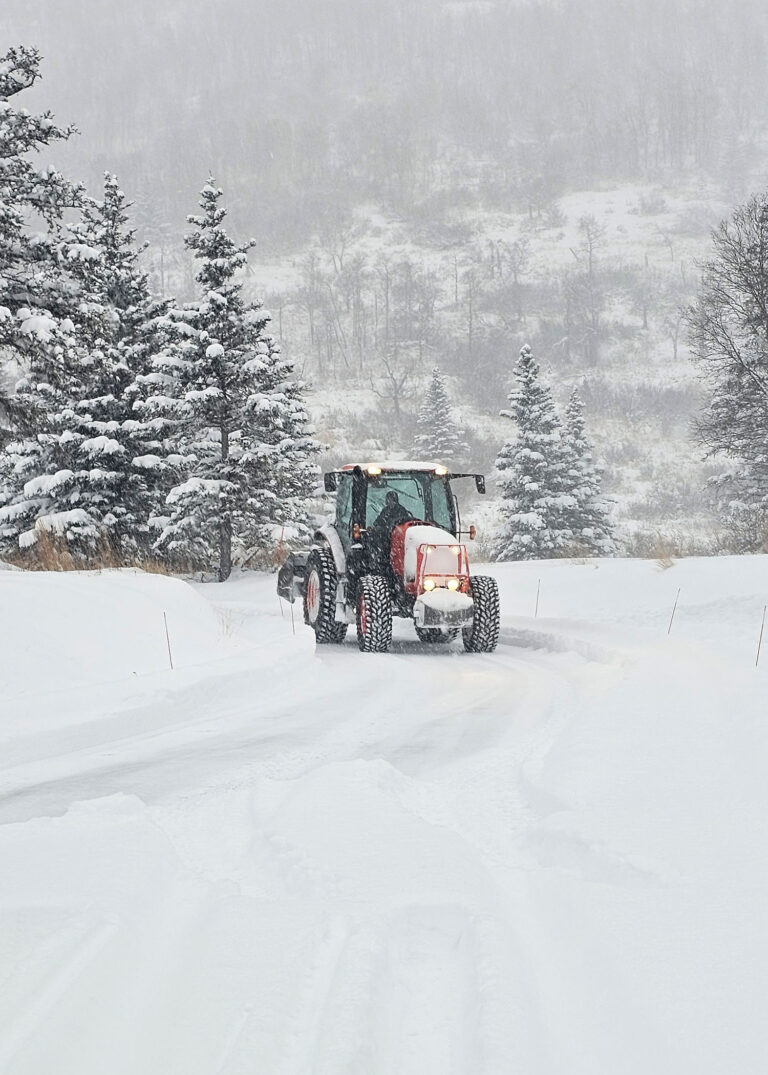
A tractor-mounted snow blower works on most Hillside driveways because it cuts the snow and throws it to the side, off the driveway and across the slope, instead of moving a pile up or down the grade. The driveway keeps its full width all winter, nothing has to be stacked, and the gravel stays in place because the blower’s shoes ride above the surface. Steep driveways are the clearest case for blowing over plowing.
Tractor blowing has limits on grade and on width. A driveway with a switchback, a retaining wall on the uphill side, or a turnaround at the top needs a site visit before the season so the crew knows where the blower can throw and where it cannot. That visit is also where the stakes go in, and on a grade the stakes matter more than anywhere else: once the slope is under two feet of snow, the edge of the driveway and the edge of the drop-off look the same.
Insider Advice: Clear a throw zone on the downhill side of the driveway before the first storm. Blown snow has to land somewhere, and a driveway with a hedge or a fence hard against the downhill edge forces the operator to throw uphill, where the snow comes right back.
Why does a steep driveway need sanding?
A steep driveway needs sanding because a cleared grade still ices, and sand is the only traction treatment that works at the temperatures the Hillside sees in January. Chloride deicers slow down below about 15°F and stop below zero; the Hillside runs colder than the bowl on clear nights, so a product that works in Midtown can do nothing at the top of the driveway on the same morning.
The sanding pattern on a grade is not the whole driveway. It is the climb, the spot where the driveway meets the street, and anywhere a car stops: the garage apron and the turnaround. On most Hillside contracts, sanding follows the blowing visit when the forecast calls for a freeze, and it can be added to a contract as a standing service rather than a call-in.
Where does the snow go on a sloped lot?
The snow goes across the slope, to the side of the driveway and downhill of it, never to the top. A blown driveway spreads its snow across the yard below the driveway edge in a layer, which melts off in spring without the ridge a plow leaves. On a lot with no yard below the driveway, the snow is thrown to whichever side has room, and when neither side has room by mid-season, the answer is a haul.
Two places snow never goes: into the street, where the next municipal pass puts it back across the entrance and where it is generally not allowed, and onto the neighbor’s downhill lot, which is where a lot of Hillside snow ends up by accident when the throw zone is not planned.
When does the municipal plow matter on the Hillside?
The municipal plow matters on the Hillside because a sloped street builds a bigger berm at the downhill driveways than at the uphill ones. The windrow picks up snow all the way down the block and unloads the most of it at the bottom, so a driveway near the low end of a Hillside street can get a berm twice the size of one near the top from the same pass. A contract that includes a return pass on plow-out days is worth more on a sloped street than a flat one.
Who does snow removal on the Anchorage Hillside?
Highmark Services provides residential snow removal on the South Anchorage Hillside, including Huffman/O’Malley, Rabbit Creek, Bear Valley, and Abbott Loop, using tractor snow blowers that clear steep driveways without stacking snow on the grade, with sanding on the climb and berm removal at the entrance on the same contract; call 907-782-6339 or visit highmarkservicesak.com to get a Hillside driveway on the route before the first storm. Highmark is now expanding residential routes into Midtown and Kempton Hills.
Frequently Asked Questions
- Can a plow truck clear a steep driveway? A plow truck can clear a steep driveway only when there is flat space at one end to stack snow, and even then it narrows the driveway with every storm, which is why tractor blowing is the standard on the Hillside.
- How steep is too steep for snow blowing? Most Hillside driveways are within what a tractor blower handles; the limiting factors are usually a switchback, a wall on the uphill side, or no place to throw, all of which are settled at the site visit before the season.
- Does sanding damage a driveway? Sanding does not damage a paved or gravel driveway; the sand is swept up in spring, and leaving it in place is what carries grit into the lawn and the storm drain.
Get a Hillside driveway on the route
Highmark Services runs established residential snow removal routes across the South Anchorage Hillside, with tractor blowing, sanding, and berm removal under one contract, and is now expanding into Midtown and Kempton Hills. Call 907-782-6339 or request a quote at highmarkservicesak.com to schedule a site visit before the first storm.